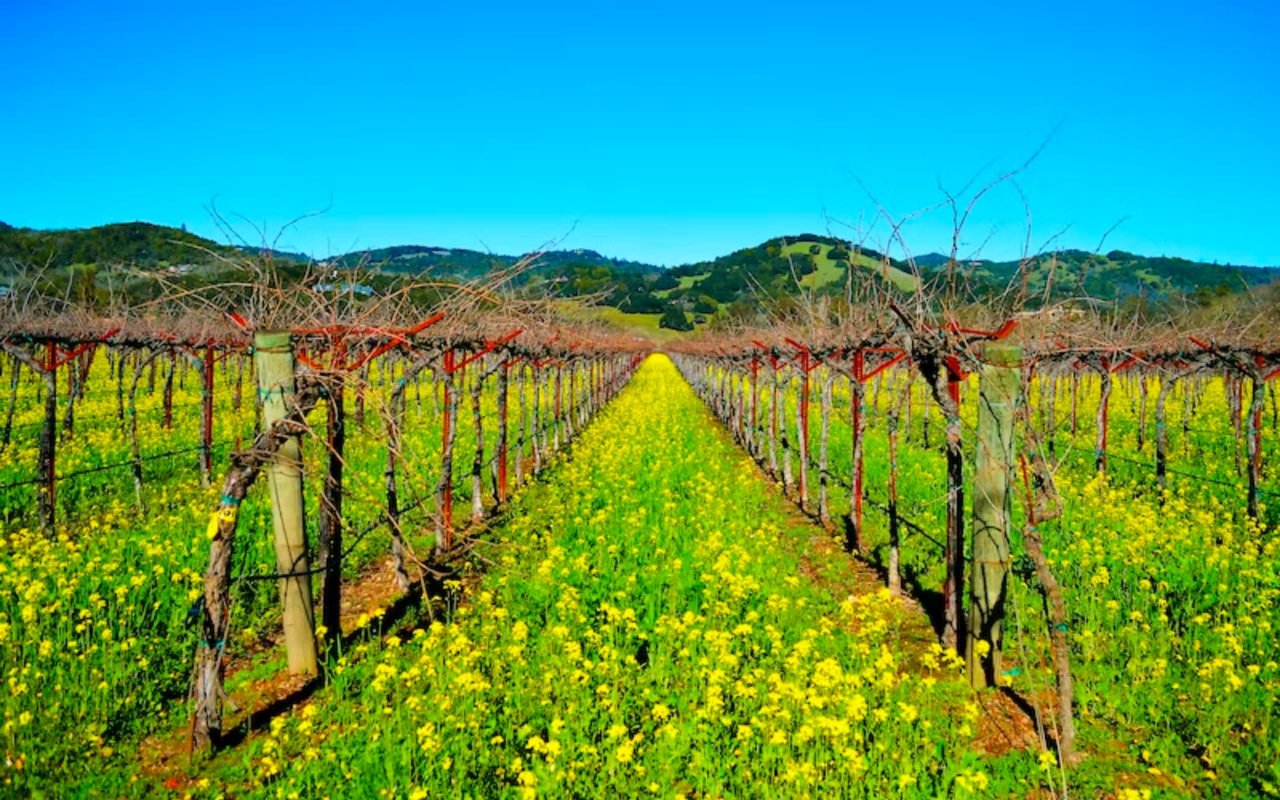
When a Napa County applicant wants to build or expand a winery without increasing a parcel's groundwater use, one accepted method has been to pull out irrigated vines. The Napa Valley Register reported that applicants meet the County's test through water conservation or "by removing some irrigated vines, perhaps for required driveway improvements."
Napa County's proposed 2026 Water Availability Analysis would turn that workaround into the normal arithmetic for much of the valley floor around the city of Napa. The draft, dated September 2026, cuts the valley-floor screening allowance from 1.0 acre-foot per acre per year to 0.5. The County's own planning guideline for irrigating a vineyard on the valley floor is also up to 0.5. On a fully planted parcel, irrigation alone could use the entire budget, and anything else the owner wants to add would need water the vines are already using.
The new allowance equals the vineyard irrigation ceiling
The 1.0 figure has been around a long time. According to the 2015 WAA, the Board of Supervisors agreed to the valley-floor criterion in 1991. In the 2015 document, the County's vineyard irrigation guideline ranged from 0.2 to 0.5 acre-feet per acre per year, with heat and frost protection listed separately at 0.25 each, so irrigation took at most half of a valley-floor parcel's allowance. The 2026 draft brings the allowance down to the top of that irrigation range.
| Area |
2015 WAA criterion |
Proposed 2026 criterion |
2026 vineyard irrigation guideline |
| Napa Valley Floor |
1.0 AF/ac/yr |
0.5 AF/ac/yr |
Up to 0.5 AF/ac/yr |
| Northeast Napa Management Area |
1.0 AF/ac/yr |
0.3 AF/ac/yr for agriculture, or no net increase for existing uses, whichever is greater |
Up to 0.3 AF/ac/yr |
| MST groundwater deficient area |
0.3 AF/ac/yr or no net increase, whichever is less |
0.3 AF/ac/yr or no net increase for existing agricultural uses, whichever is greater |
Up to 0.3 AF/ac/yr |
The 2026 draft also lists heat protection and frost protection at 0.25 acre-feet per acre per year each. A block that needs both irrigation and frost protection can go over 0.5 before any house is counted.
How a winery plan gets paid for in vines
Take an illustrative 20-acre parcel on the Napa Valley Floor with 16 acres of vines.
- Under the 2015 criterion, the parcel's screening allowance is 20 acre-feet a year.
- Under the 2026 draft, it is 10 acre-feet.
- At the guideline ceiling, irrigating 16 acres uses 8 acre-feet. That leaves 2 acre-feet for the residence, landscaping and any new use.
- If frost protection runs across all 16 acres, it adds 4 acre-feet. The parcel is then over the 2026 allowance with the vineyard alone.
The draft's guideline for winery process water is 2.15 acre-feet per 100,000 gallons of wine, plus 3 gallons per tasting-room visitor and 15 gallons per visitor for events with a commercial kitchen and on-site catering. At the 0.5 guideline, the process water for 100,000 gallons equals the irrigation for a little over four acres of vines. Under the valley-floor allowance, it is the same water.
This is why "plantable acres" and "winery potential" can't simply be added together in a listing description. Under the draft, they draw on one fixed budget. The proposal applies to groundwater uses that are new, change place of use or source, or increase intensity on a parcel. That covers the winery use permits, vineyard development and some residential projects the draft names as discretionary examples.
Just northeast of town, the cut is deeper
The steepest change lands close to the city. The Northeast Napa Management Area covers about 2,087 acres just northeast of the City of Napa and extends into the Milliken-Sarco-Tulucay area. It was first designated as a subbasin management area in 2017 because its hydrogeology is unlike the rest of the subbasin. The 2026 draft would make it a separate WAA area for the first time.
The staff report says the area's previous criterion was 1.0 acre-foot per acre per year and the proposal carries over the 0.3 threshold already assigned in the groundwater sustainability plan. For an owner in that pocket, the per-acre budget for a new or intensified use would fall by more than two-thirds. Domestic use there is set at 0.3 acre-feet per acre per year on parcels of one acre or less, with a 0.6 acre-foot annual cap.
Outside the subbasin and the MST, in places the draft names as Carneros, Pope Valley, Wooden Valley and Capell Valley, there is no single number. The allowance is based on parcel-specific recharge, using either a County-supplied streamlined calculation or an analysis by a registered professional engineer or geologist.
A parcel's water history now carries value
If the water budget is fixed, the records that prove a parcel's existing use become part of what a buyer is paying for. On a valley-floor parcel already above 0.5, a replacement well is held to no net increase over existing use. Getting replacement status at all depends on documentation. The draft requires the old well to have been in active use for at least one year of the most recent five. The applicant must show that with records such as electrical bills, flowmeter readings or maintenance logs, and must properly destroy the old well. A well that has sat idle on a fallow parcel for longer than that may not qualify.
Metering is becoming standard. At the October 13 Board session, Patrick Ryan, assistant director of Planning, Building and Environmental Services, said metering will be required for projects that change or intensify water use, according to the Napa Valley Register.
The neighbors count as well. The proposed Tier 2 screen looks at off-site wells within 500 feet and springs within 1,500 feet. Its default drawdown limits are 10 feet at a neighboring domestic or public-supply well and 15 feet at an agricultural, commercial or industrial well. Before treating a parcel's development potential as settled, a buyer should ask:
- Which WAA area is the parcel in, and what does its criterion allow across the full acreage?
- How much do the existing vines, residence and landscaping use against that number?
- Is there meter, power or maintenance documentation showing each well's active use within the last five years?
- Are there neighboring wells within 500 feet or springs within 1,500 feet of a planned well site?
- How far is each existing or planned well from a County-designated significant stream?
The stream setback adds a second limit
The staff report calls the Tier 3 stream provisions the most significant changes in the draft. They apply to new, replacement and existing wells within 1,500 feet of a significant stream, meaning one that supports aquatic habitat or has a Strahler stream order greater than one. The proposed seal depths for new and replacement wells get deeper closer to the stream:
- Within 500 feet: 150 feet or more, plus siting as far from the stream as feasible, metering and reporting, and conservation measures
- 500 to 1,000 feet: 125 feet
- 1,000 to 1,500 feet: 100 feet
In the Napa River Watershed, existing uses already over the applicable criterion would need to reduce stream depletion at the project level. So two parcels with the same acreage and the same criterion can end up with different usable budgets depending on where their wells sit.
Where the proposal stands
The October 13 session was for feedback only. The County's meeting recap says staff will return with the updated 2026 WAA for the Board's consideration and potential adoption. Supervisor Anne Cottrell told the Napa Valley Register, "We're heading in the right direction, and there's more work to be done."
Public comment covered a wide range. In the same Register story, Michelle Benvenuto, executive director of the Winegrowers of Napa County, said, "Making it harder to farm won't leave more water in the ground. It invites uses that will need more water." William McKinnon, an attorney for Water Audit California, wrote that the County's test "asks whether a project depletes less than the parcel did before," while the public trust doctrine "asks whether the extraction harms trust resources and what feasible measures will protect them."
Owners on the subbasin are also paying Groundwater Sustainability Agency fees. On August 11, 2026, the GSA temporarily set FY 2026–27 fees at $17.53 per planted acre plus $26.91 per groundwater-irrigated acre, and $28.17 per self-supplied parcel. The staff report says those rates are about 55 percent below the fee-study rates of $38.58 and $60.16 per acre, and that they revert to the fee-study amounts in FY 2027–28, with CPI-U adjustments capped at 4 percent a year.
A few questions that come up often
Does the draft affect a vineyard I already farm, with no changes planned?
The proposal is triggered by groundwater use that is new, moves, changes source or intensifies. Replacing a well, adding a winery, or adding a residence or other new use is what brings a parcel into review.
Do single-family wells go through the WAA?
The draft requires a WAA for any water-supply well. Ministerial wells can get expedited review if they meet Tier 1.
Where can I read the full proposal?
The Board item and staff report and the public draft WAA are posted on the County's Legistar site. The 2015 WAA is available for comparison.
This post is general information about a proposed County policy. It is not legal, tax or financial advice. Confirm how the rules apply to a specific parcel with County PBES staff, a registered hydrogeologist or engineer, and your own advisors.
Mark worked as a Farm Credit officer and as a winery CFO, and in that work a parcel's water was always part of its valuation. If you are weighing a Napa vineyard, winery site or estate where water use will decide what the land can become, Mark Stornetta can help you work through the well records, acreage and plans before you commit. Request a Confidential Consultation.