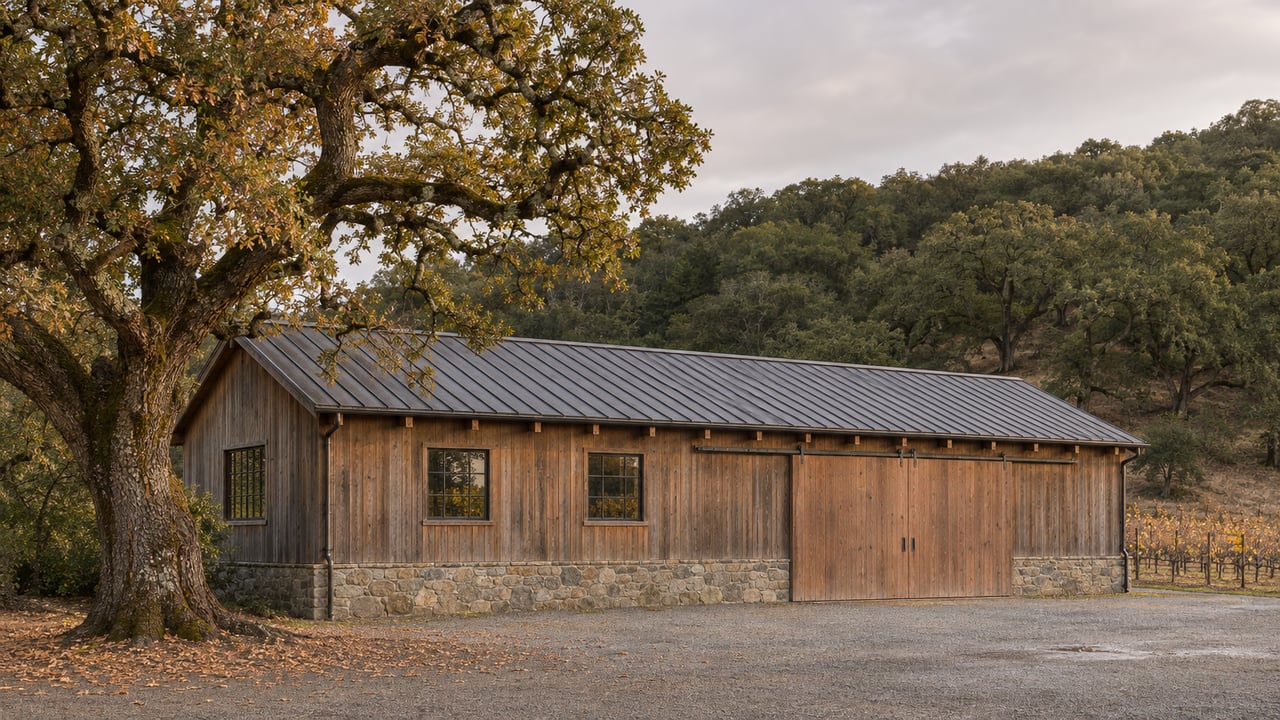
"We're going through all the inventory over there right now to find out what's there and if it's any good. It may be wonderful, it may not be." That is how Gary Heck, owner and president of F. Korbel & Bros., described his first weeks back at Kenwood Vineyards to Wine Spectator in April. Twelve years after he sold the winery, he was opening barrels to find out what he had bought back.
Heck's company paid $4 million. According to public records reported by the Press Democrat, the nearly 33-acre winery property at 9592 Sonoma Highway sold on March 26, 2026, to Kenwood Winery Land LLC, a company Heck leads. Anyone comparing winery or estate property in Kenwood should understand how that number came about. It shows that once a Sonoma Valley winery is separated from its vineyards, its price depends on how few buyers can actually use it. History and the last sale price have much less to do with it.
The 2014 price bought a business
When Pernod Ricard bought Kenwood from Heck in 2014, the deal covered the brand, the inventory, the facilities and four vineyards. According to a history of the winery published by Sonoma County Winegrowers, the deal was reported at about $100 million. The Press Democrat reported that county records valued the real estate portion of that acquisition at $7.2 million.
The $7.2 million and the $4 million describe different property, so the gap between them does not measure a decline in the same asset. In 2014 the winery came with its own fruit. By the time Pernod sold, it had already sold several of Kenwood's key vineyards, including the Jack London Vineyard. Wine Spectator called that vineyard the lynchpin of the winery's Cabernet portfolio in its heyday.
|
2014 sale to Pernod Ricard |
2026 sale to Heck's company |
| Real property |
Facilities plus four vineyards |
Nearly 33-acre winery estate, about half planted |
| Brand and inventory |
Included |
Included |
| Reported figure |
About $100 million for the whole deal; $7.2 million for the real estate in county records |
$4 million recorded for the real property |
Pernod Ricard's own closing announcement describes the transfer as Kenwood's operations and trademarks, with production facilities, a visitor center and about 20 acres of vineyards. Divide $4 million by 33 acres and you get about $121,000 an acre, with a working winery and tasting room included. That figure only makes sense once you see who was in a position to pay it.
A winery built for volume needs fruit and a brand to fill it
The site has been making wine for a long time. Amedeo Pagani bought the land in 1905, and the family built a bulk winery there in 1906 that operated through Prohibition. In 1970, John Sheela and his brothers-in-law Mike and Marty Lee turned it into Kenwood Vineyards. By the 1990s it was making 250,000 cases a year, with an estate vineyard of about 200 acres at its largest. Under Heck's first ownership, production grew from under 300,000 cases to more than half a million.
A facility built for that kind of volume is a liability for an owner without enough grapes and enough sales to keep it running. The Press Democrat reported that Pernod Ricard had filed notice of a closure of the winery effective March 31, days before the sale closed. Kenwood had become Pernod's last wine holding after the company sold Mumm Napa to Trinchero Family Wine & Spirits in December 2025.
Heck already had most of what the winery needed. He plans to supply Kenwood from the roughly 1,000 acres of vines Korbel owns, and he knew the brand from building it the first time. "We made some great wine [at Kenwood] and we made a lot of good wine at a fair price," he told Wine Spectator. "And, you know, I think that's really what we want to do again." For a buyer with that much fruit and a brand to sell, the buildings on Highway 12 can go straight back to work. For a buyer starting from nothing, the same buildings are a large fixed cost waiting for a business to support them.
The property is operating again. In a release carried by WineBusiness, the winery announced that its tasting room, in the historic 1906 barn, would reopen on Friday, May 15, under Heck family ownership.
In the 2026 market, grapes are cheap and brands are scarce
The grape market makes this split sharper. In the preliminary 2025 crush report, published in March 2026, Sonoma County Chardonnay averaged $2,367 a ton, according to the Press Democrat. In its March 2026 assessment, Turrentine Brokerage put spot prices for that Chardonnay closer to $800 a ton. When fruit sells on the open market for about a third of the district average, owning vineyards is no great advantage. What's scarce is a label with distribution that can turn those grapes into sales.
The 2026 harvest was light. In its October 19 statement, Sonoma County Winegrowers estimated the crop at 35 to 40 percent below average and said wineries were buying additional grapes, which CEO Karissa Kruse hoped would help rebalance the local market, as reported by WineBusiness. One short crop doesn't change who is able to buy a large winery.
Winery valuations show the same scarcity. At a May 2026 industry conference covered by the Press Democrat, Zepponi said the most sought-after vintners sold for more than 20 times EBITDA during the 2021-22 deal boom. He put today's standard multiple at about 8 to 10 times, and 3 to 5 times for asset-light brands. His advice to owners was "If you don't need to be on the market, don't be in the market." Appraiser Tony Correia, speaking at the same event, described North Coast vineyard land with "lots of sellers, and there's very few buyers," and added, "All of Sonoma County, if you have to sell today, the prices are going to be less than they used to be."
Glen Ellen shows a corporate owner splitting the brand from the building
Farther down Sonoma Highway, a different corporate owner made a similar choice. The Wine Group put its Imagery Estate Winery property at 14335 Sonoma Highway in Glen Ellen on the market in mid-November 2025, the Press Democrat reported in January. The site has a 55,000-square-foot production facility and tasting room and is licensed for up to 180,000 cases a year, but The Wine Group had not made wine there for the previous two years. The company said it would keep the Imagery brand, and that it might lease the tasting room back from a buyer or move Imagery's direct sales to nearby Benziger. Just Drinks put the estate at around 19.6 acres, with about 3.8 net acres planted.
Both Pernod and The Wine Group treated the brand and the land as separate assets. When a company keeps the label and lets the property go, the building's value rests on what a buyer with their own brand, or a tenant, will pay to use it. A plant licensed for 180,000 cases that has sat idle for two years shows how much the price depends on who is buying. More on the area is on our Glen Ellen page.
What a Kenwood buyer should ask before trusting a past price
For anyone weighing a vineyard estate, a winery-capable parcel or an existing winery between Kenwood and Glen Ellen, the Kenwood sale makes four questions worth answering before you rely on an earlier sale or an assessed value:
- Which vineyards are still on the deed, and which ones once supplied the property but now belong to someone else?
- Is the brand and inventory part of the sale, or is it real property only?
- How large is the facility compared with the fruit you control or can reliably buy?
- Who else has both the grapes and the sales to run this building at the scale it was built for?
These questions apply well below the scale of Kenwood Vineyards. A Kenwood estate with a small block of vines and a production barn is priced the same way, on what the next buyer will actually use it for. For a related look at Napa, see Napa Grape Prices Are Crashing. Vineyard Land Isn't Following., and for the village itself, see our Kenwood page.
The figures above come from published reporting on 2025 and 2026 transactions. They are general information, not tax, legal or financial advice, so confirm how they apply to a specific property with your own advisors.
If you own a vineyard or winery property in Sonoma Valley and want to know who could actually use it, and what that pool of buyers means for its price, Mark Stornetta can work through the numbers with you, drawing on his years as a Farm Credit officer and winery CFO. Request a Confidential Consultation, and for properties that call for a quieter approach, ask about Private Exclusives.